5 ways to get a student to stick with music

Which is worse?

“I used to play the flute and then I quit in sixth grade. I’ve always regretted it.”

or

“I was forced to play the flute all throughout my childhood, and I hated it. I’ve never recovered from the psychological damage that ensued from being forced to do something I didn’t enjoy and I’ll never get over it until the end of time.”

Feels like being between a rock and hard place, doesn’t it? Here are five ways to split the difference, getting your student to stick with music.

When the going gets tough, consider these tips:

1. Make sure it’s the right instrument

Gauge whether they really do want to study that particular instrument. If not, consider changing it.

2. Pick the right music​

If scales and Bach are getting monotonous, add in some Disney songs or arrangements of pop music. It’s okay to spice it up.

3. Find the right teacher

No matter what your goals are with music, the right teacher will make the activity fun while still stretching them to reach new heights. It is a delicate balance, but in my opinion, meeting the student where they’re at and finding where they have the most fun is key to their success and growth.

4. Make it fun

If they have a problem practicing (which most kids do), think of it as any other discipline they need to build. Memorizing multiplication, doing homework after school before dinner, brushing teeth, etc. Sometimes, a little touch of bribery can be worth it. If they practice 10 minutes a day for a whole week, perhaps they can go out for ice cream or watch an extra hour of TV. There’s also the natural reward of playing really well at their concert or audition.

5. Connect it to real life

Generally, music is scientifically something that reduces stress and promotes enjoyment. It can be an escape from the daily grind activities like school, while also helping to improve academic performance.

Going to concerts is a great way to see music in context. Music can also be a good motivator for getting other opportunities, like college scholarships, new friends, and more.

In the end, if music is not their thing, accept it and move on. Allow the developing person to be who they are, and allow them to figure it out by trying out different methods. Music can always be a positive step on that journey.

Other articles on music lessons and cognitive growth:

How much should you mark up your sheet music?

Writing on something that is already published is controversial. Remember back in English class when you were asked to *annotate* in the book? This is not too far off. Some teachers feel that a well-marked piece of music shows how well the student learned it. However, beware of the downfalls of this popular belief.

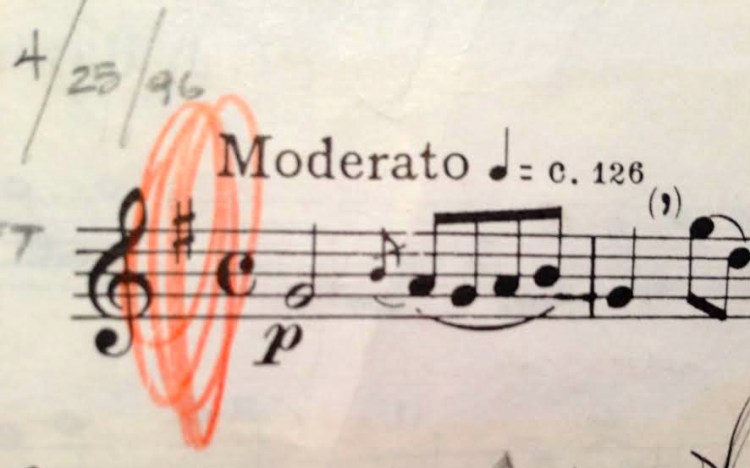
Here is a picture of a piece I played as a child. Look how beautifully I marked it up!6271401_orig

The best part about this is how I mixed regular pencil with red pencil. Of all the glorious colors in my Polly Pocket pencil case, I chose red because it is urgent and alarming.

I was so full of anxiety that I thought this would surely scare me into playing this piece right!

This key signature looks like it is on fire.

2449056_orig.jpg

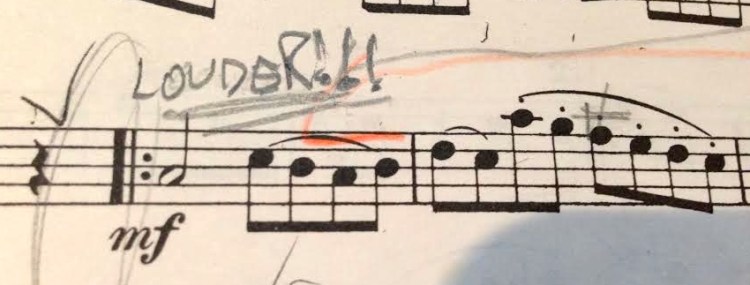
Even though this is marked in regular pencil, there is no subtlety here. “LOUDER!!!

8652138_orig.jpg

In case you forget what it takes to make a sound on your instrument, break it down to its simplest explanation.

Here, “Just blow” is put in a drawn in box, accompanied by several breath marks.

6674680_orig

And then, my favorite.

1032984_orig.jpg

JUST CONSINTRA
TE
,
” it says across the entire top of the page in terrifying capital letters, followed by a never-ending arrow that winds in between the staff lines. Perhaps I meant this no nonsense command to take place only where the arrow ends. Or was it for the entire piece?
(Scholars will obviously investigate this for years to come.)You might have guessed that the normal pencil markings were put in first, and they got darker, more jagged, and panicked as time went on.

Of course, I whipped out the red pencil right before the recital, in an act of desperation when my brain pleaded with…my brain…to actually do what was on the page to begin with.

You might be wondering how my performance of the above piece went. Unsurprisingly, it was as panicked and anxiety-filled as the markings on the page.

What can we notice from this, other than my interpretative spelling?

1. There is no shame in marking up your music.
Seriously, there really isn’t!

2. However, don’t overdo it!
If there are too many markings, you will literally start to not see them. Not only does it get confusing to look at, but additionally, studies show that looking at any one thing for too long will actually make your brain tune it out. Not helpful if you genuinely want to concentrate.

3. Therefore, PENCIL is usually your best friend in these markup situations.

Why?

The eraser, of course.

Believe it or not, 17+ years after the fact, I still cannot erase the red pencil from this piece of music. Unless you plan on blogging about this later in life (which is cool), stick with the classic pencil, especially if the piece of music is an original copy, on loan, or both.

pencil-152713_1280.png

However, when you do start marking, do what you like as long as it is beneficial. By all means, if drawing ornate colorful landscapes or funny faces is what inspires your interpretation of the music, go for it.

4. For basic markings like notes and breaths, simpler is often better. In other words, be polite to yourself. Take a breath (no pun intended) and calm down before getting carried away with smoldering exclamation points and giant letters.

After I shared this infamous red pencil story with one particularly great student, she used humor to learn scales.

1394026384.jpg
 In the end, whatever works for you works for me.

How You Learn

In a flute lesson with a student recently, we were working on a section of music that involved a lot of long notes tied together. At a fast tempo, it was challenging to count and stay on track simultaneously.

So, we tried it a few different ways. First, she counted out loud while I played the passage. This way she could see where the notes changed, and on what beats.

Then, we switched roles – she played while I counted out loud. When she was still stumbling a little bit, we repeated this process, but we replaced playing with singing. Things were improving slightly, but we weren’t out of the woods yet.

So, we took a pencil and wrote in slash marks where the big beats were. We zoomed in on the specific spots where the notes changed, and then wrote in the beat numbers on top of the notes.

It went much better! Just one more thing.

“Don’t play that note so long,” I pointed out. She nodded vigorously.

She tried it again, but made the same mistake, and we both laughed. Then, I tried putting it in a different way.

“Play that note a little shorter,” I said.

Success.

Things were improving, but there was still a little uncertainty. Each time we repeated this process, we took a little step forward and a little step back. I could see her mixed emotions. Frustration and clarity. Self-doubt with understanding. Her energy was palpable. Being the good student that she is, she wanted to get it, and get it as quickly as possible.

With a couple more tweaks, she finally got it!

Then, I told her to do it two more times “for good luck”. The first time was good.

“Great,” I said. “You’re doing it. One last time and then you’ll be golden.”

I knew I was putting the pressure on now. Predictably, she stumbled again on that second try.

We both laughed, and then we started talking really fast at the same time. I stopped and let her go first. She took a deep breath.

“I will just work really, really hard on this on my own, and it’ll be fine,” she said triumphantly.

I took a moment to think. Then, the whole situation hit me in a different way.

“You know what?” I said. “No. Working really, really hard on this is not what you need. I know you can do it. You know you can do it. You just did it. This is just a matter of relaxing, trusting yourself, and letting yourself count. That’s all this is.”

“Oh,” she said.

“Shake it off and try it again. Just play.”

Success. Then, I told her to leave it, and come back to it another time, remembering the place she left it today.

In the end, giving her permission to see through the anxiety and find herself was what made all the difference.

Do you have a story about learning? I’d love to hear it. Leave it in the comment section.

How I Teach

  • Assessing Individuals

As a private teacher, I enjoy being able to approach each student as an individual. Some want to win competitions while others want to focus on learning songs they know. Balancing fun with growth, technique with musicality, and achievement with confidence are my ways to success as a teacher. I can assess each student’s goals and ability to learn by fostering what works best for them.

  • Technique vs. Musicality

Technique is very important, but so is playing music! We must never forget that playing music is what we’re here to do. In addition to requiring everyone to be comfortable with all scales, fingerings, and other basic foundations of the instrument, I provide and promote exposure to a variety of music, both in the flute genre and outside of it. This combination inspires and stimulates my students’ musical consciousness.

  • Fostering Community

At the heart of all I do, I seek to be a role model and friend for my students, fostering a sense of community amongst them and myself. I do this by encouraging collaboration. Whether coordinating chamber music and performing recitals, or providing other means of continued learning, I believe connecting with peers and learning from each other is how studying music can benefit them in a myriad of ways in life.

Triplets

Cute right?

But no, I’m not talking about babies.

I’m talking about this funky rhythm:

7178408

Dictionary.com:
Music. a group of three notes to be performed in the time of two ordinary notes of the same kind.

Why are there three notes under one flag? What does the little 3 on top mean?

This usually stumps everyone at first.

In basic rhythm (and life), things are usually divided into two’s.

9285340_orig

Therefore, two evenly spaced notes usually happen within the time period of one longer note.

But now, we are putting things into three’s instead of two’s. The triplet means that there are three evenly spaced notes under one beat.

So, think of a three-syllable word. How about MEXICO or ERENBERG or TRI-PUH-LET, as some people say.

Now start snapping your finger once on the first syllable of that word. Look at a ticking clock, or put a metronome on. Then, start saying that three syllable word in the space between each beat, with the actual beat landing on the first syllable.

Check out these videos for some real life examples and different ways of explaining it.

Triplets – Understanding Rhythm and Notation…

Triplets: Music Theory

In the meantime, can you think of any popular songs that have triplets? List them in the comment section!